
Gaming was my reason to stay on Windows. CachyOS changed that
Gaming was one of the biggest things holding me on Windows. A lot of my time with friends happens in games, and changing operating systems did not feel worth it if I lost that part of my life.
About 90 days into using CachyOS as the only operating system on my personal PC, I have not needed to set up a Windows dual boot. I can still play the games that matter to me.
That is the result I care about most. It is also a much narrower claim than saying Linux is the best operating system for every gamer.
The adoption numbers I looked at
In the recording I pull up two Statcounter North America charts. The first covers operating systems across device types and showed Linux at 8.47% in its August 2026 page header. The desktop-only North America chart showed 16% for that month. I said “global” while browsing and read slightly different percentages aloud, but the page headers recorded on screen give those regional figures. Statcounter explains its method: the data comes from page views on sites using its analytics code. It is not a count of installed PCs or of Linux gamers, and the live figures can change.
The August 2026 Steam Hardware & Software Survey offers a different lens: Linux was 3.90% of participating Steam users, while Windows was 93.95%. Steam says its survey is optional and anonymous. I would not combine the Steam and Statcounter percentages into one adoption number; they cover different populations.
One computer, two jobs
My current machine is a Strix Halo system with an AMD Ryzen AI Max+ 395, Radeon 8060S graphics and 128 GB of unified memory. It handles local-AI projects and everyday work, then becomes a gaming PC when I want to play.
I used to separate those things. A dedicated gaming rig, a different setup for other work, more equipment and more expense. I would rather keep one machine useful for the way I actually spend my time.
My monitor is a 60 Hz productivity display. I am not trying to feed a 144 Hz competitive setup, and I have not optimized these games to get the highest possible frame rate. What feels acceptable to me may be a poor fit for someone with different games, a different display or a different tolerance for uneven motion.
I also wish I had taken proper measurements before leaving Windows. Some games have felt a little better since the switch, but that is my impression. I do not have a matched Windows baseline that proves it.
What my four games felt like
I recorded gameplay and performance data for four games I actually play: Slay the Spire 2, Rocket League, ARC Raiders and Overwatch. The point was to preserve what CachyOS is doing now before I change the system again.
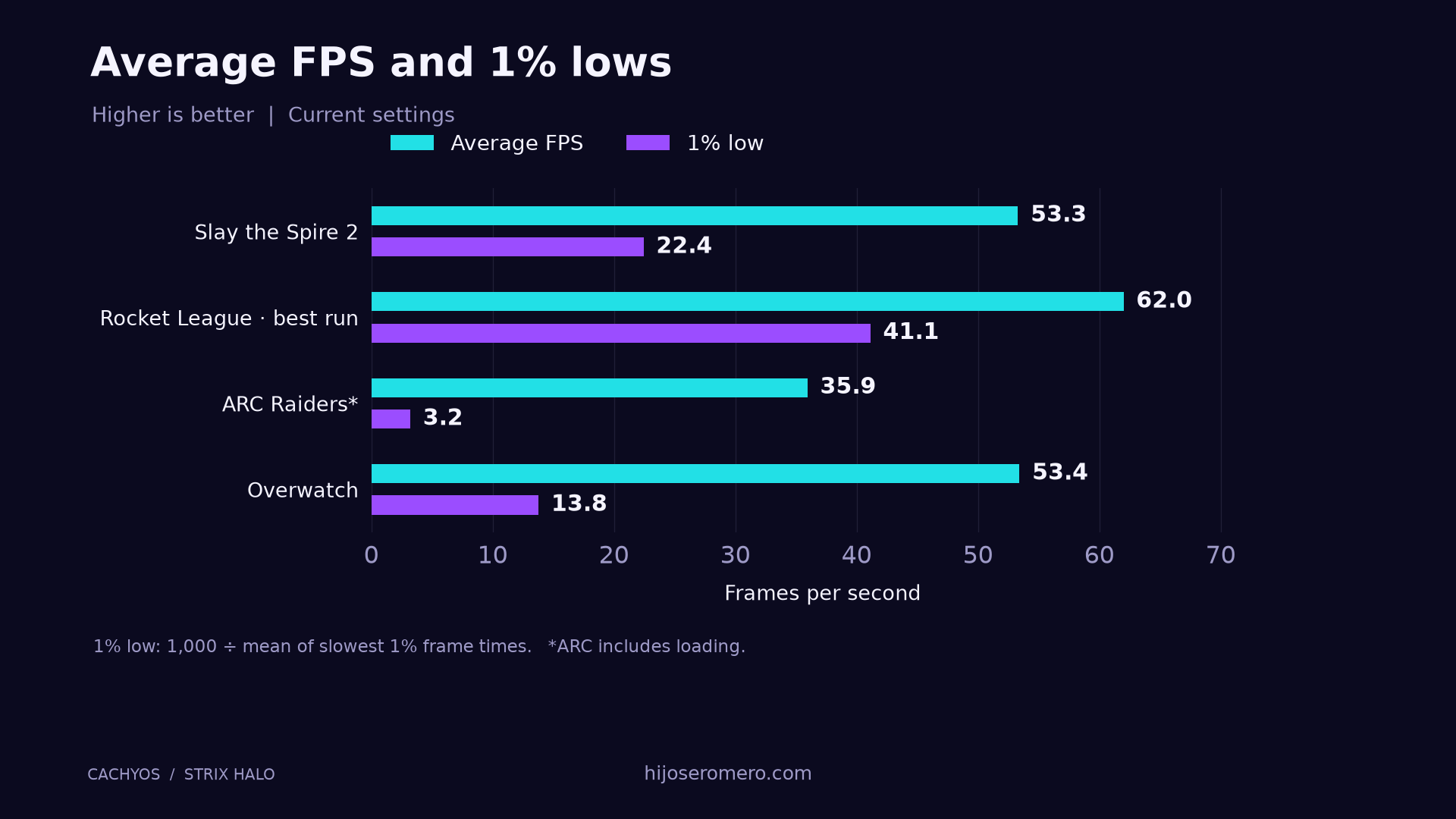
Slay the Spire 2 is one of my go-to games, both alone and with friends. It felt smooth to me, and I did not notice issues that got in the way of playing. It is a deck builder, so it asks something very different of the machine and of my reactions than a fast shooter does. The logged average was about 53.3 FPS, which also shows why a summary number does not capture every part of how I experience a game.
Rocket League was solid enough for me too. I checked that my Xbox controller worked, although the recording uses mouse and keyboard. The chart shows about 62.0 FPS from the run with the higher average; the gameplay footage comes from a separate run. I had no major complaint about playing it, but I am not presenting those two sessions as identical controlled tests.
ARC Raiders needs the most context. I started logging during deployment and loading, then discovered afterward that the quality preset was Epic. The settings screen showed AMD FSR Balanced, with 2024×848 internal rendering upscaled to 3440×1440. That matters when interpreting the roughly 35.9 FPS average.
The loading portion is still included in the result. Very slow frames there should not be described as a sustained gameplay frame rate, or silently removed to make the result look better. Running around the map was usable for me. This particular recording mainly shows traversal and exploration, not a demanding firefight.
Overwatch ran well enough for me to play and enjoy. At about 53.4 average FPS, it felt a little less smooth than the other games in places, especially while tracking Doomfist's movement. The settings mixed Medium with lower options. I could try a lower resolution to see whether that improves those moments, but this video does not include that follow-up test.
Those differences are why I wanted both the footage and the numbers. An average helps describe a run. It does not tell me whether I am enjoying the game.
What the memory numbers mean
The charts show whole-system RAM use in roughly the high twenties through low forties of GiB across these sessions. That includes the operating system and other activity. It is not a statement that each game requires that much memory.
This is also a unified-memory machine. The GPU memory readings are not a separate physical pile of memory to add on top of the system number. With 128 GB installed, the reported usage in these sessions is comfortably below half the machine's capacity.
The frame-time graphs describe how long frames took. They are not measurements of input latency. And none of these captures establishes a CachyOS advantage over Windows or Fedora.
Why Fedora is still next
The reason I am considering another distribution is mostly my local-AI work. CachyOS's frequent updates and the setup expectations of some projects have created friction for me.
For that next test, I am looking specifically at kyuz0's AMD Strix Halo Llama.cpp Toolboxes, a project providing prebuilt containers for local language models on this hardware. I want Fedora to fit that toolbox setup better and reduce the churn of frequent system updates. The project supports several container workflows; it is not exclusive to Fedora.
I am looking for a steadier system with less frequent host updates. That is a hoped-for benefit, not a stability result I have already measured. The open question is what, if anything, I give up in gaming performance or compatibility. These CachyOS recordings give me something to return to when I make that comparison.
If gaming is what keeps you on Windows, I would start with your own library. I use ProtonDB to look at game reports and the details people share about their setups. Compatibility can depend on the title, its updates and features such as anti-cheat. Check the games you would actually miss before changing your machine.
I also showed a Command Linux article about Steam Linux Runtime statistics. Its chart estimated about 9,000 native Linux builds and about 106,000 games playable through Proton using November 2025 figures. Those are that article's historical estimates, not a current verified count or a promise that every game in a library works. ProtonDB and current per-game reports are more useful for an actual switch.
If Windows works for you and you do not want another project, there is no obligation to switch. For me, Linux has become practical enough that gaming is no longer the automatic dealbreaker it once was.
Which game would make or break the move for you?
🎥 Gear links
Affiliate links may earn me a commission at no extra cost to you. As an Amazon Associate I earn from qualifying purchases.
- Sony a6700 with 16-50mm kit lens (camera recommendation) (Amazon (paid link))
- Shure SM7B dynamic microphone (the mic in every video) (Amazon (paid link))
- Cloud Microphones Cloudlifter CL-1 mic activator (+25 dB clean gain for the SM7B) (Amazon (paid link))
- Focusrite Scarlett Solo 4th Gen USB-C audio interface (Amazon (paid link))
- Audio-Technica ATH-M50x closed-back monitor headphones (Amazon (paid link))
- ADAM Audio D3V desktop studio monitors, black pair (Amazon (paid link))
- GMKtec EVO-X2 AI Mini PC, Ryzen AI Max+ 395, 128GB LPDDR5X, 2TB SSD (my rig) (Amazon (paid link))
- Logitech G PRO X Superlight 2 wireless mouse, black (Amazon (paid link))
- ALTSON 60 LED portable video light, CRI 97+, rechargeable, clip + tripod adapter (my key light) (Amazon (paid link))
Sources and tools
- CachyOS
- ProtonDB game compatibility reports
- Steam Hardware & Software Survey, the source shown in the video
- Statcounter operating system share in North America
- Statcounter desktop operating system share in North America
- Statcounter methodology
- Command Linux Steam Linux Runtime statistics, historical estimates shown in the recording
- Fedora
- AMD Strix Halo Llama.cpp Toolboxes
- MangoHud
- amdgpu_top
- sysstat